Xanthorrhoea
arenaria (sand grasstree) is endemic to Tasmania and
is considered a threatened specie.
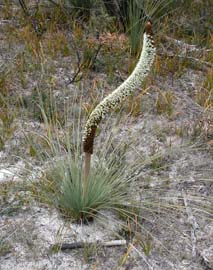
A tuft of erect leaves that form a crown emerge from a
caudex (basal stem) that is below ground. Several
crowns develop. The blue/green, needle like leaf
blades are 40-80cm in length, 2-3mm wide and 1-2.5mm
thick. Established plants can regenerate after injury.
A Flower spike is held erect on a scape 20-60cm in length
and 8-11cm in diameter. The spear like spike of
flowers can be 7-40cm long and 2-3.5cm in diameter. A
spike of flowers is generally longer than one third but less
than half the length of the scape. Multiple spikes of
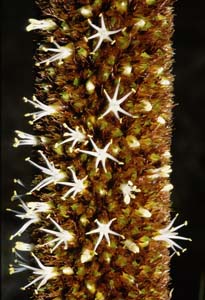
flowers can be produced in a single flowering. Bracts
surrounding the individual flowers are prominent. The
outer perianth segments are smooth, have an acute apex and
taper to a long beak. Flowers June to January but does
not flower consistently every year. Flowering is
considerably increased after a fire event.
Individual capsules contain a few black, flat, oval
shaped seeds.
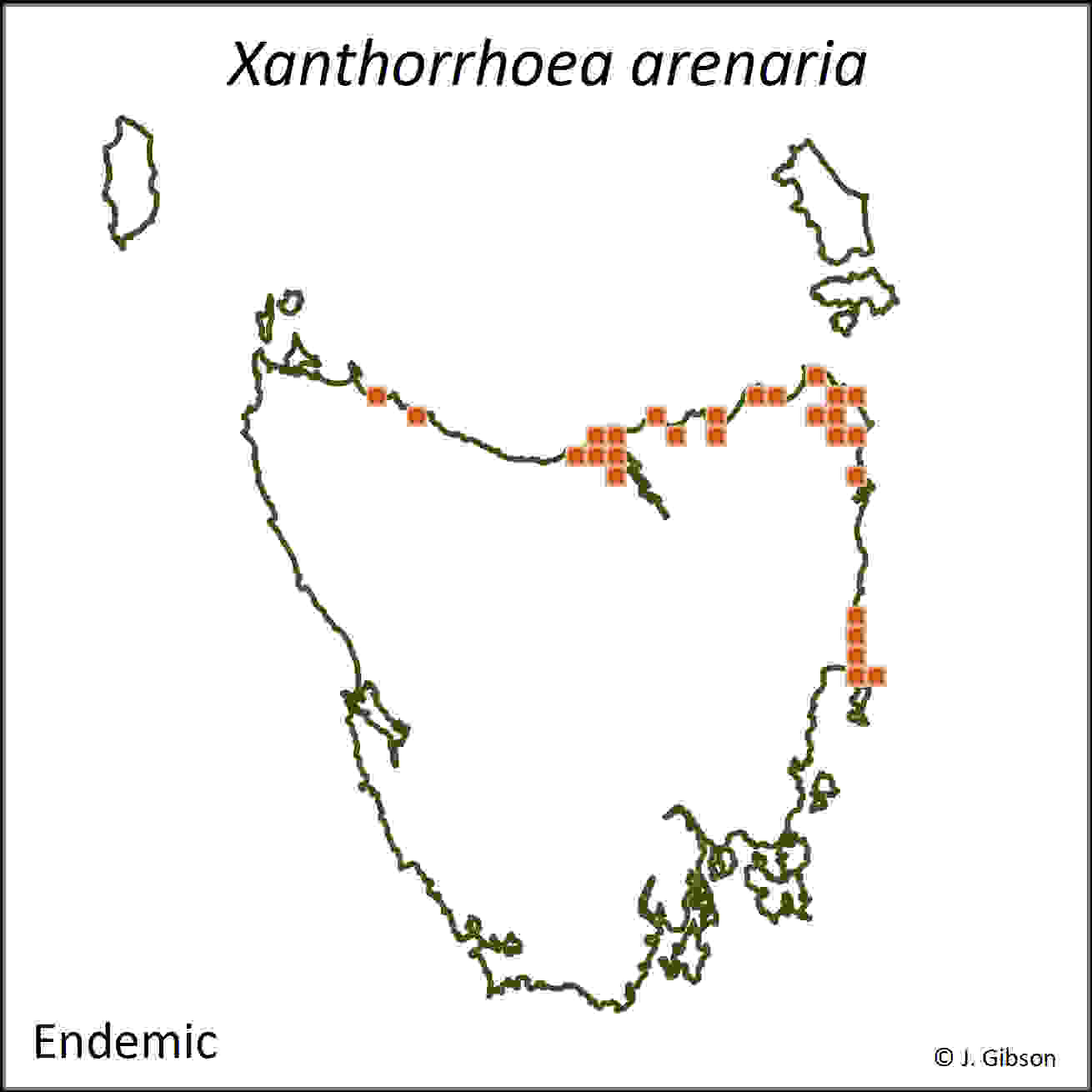
Grows in coastal sandy heaths in the North East and East
from Bridport to Coles Bay.
X.
bracteata and X. arenaria are very
similar making it difficult to discern one from the
other. The area or location they are found can be of
assistance.
|

 Back
Back

 University of Tasmania