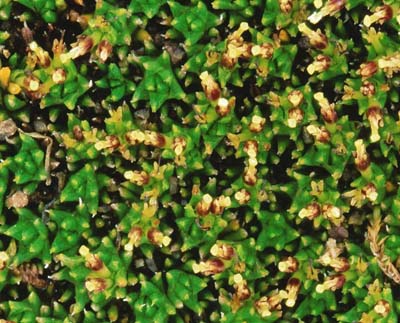
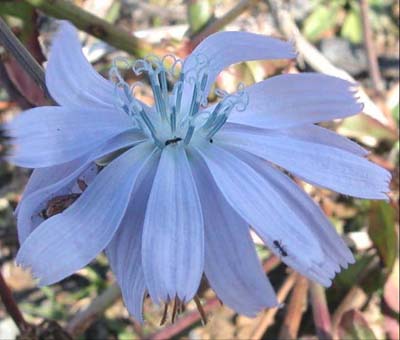
1.
Abrotanella forsteroides
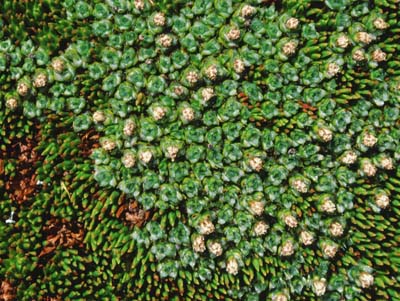
2. Pterygopappus lawrencii
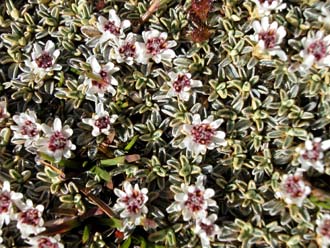
3. Ewartia meredithiae
4. Olearia glutinosa
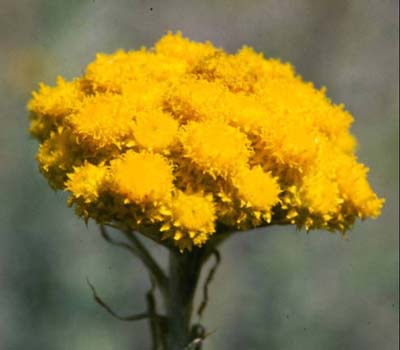
5. Chrysocephalum semipapposum
6. Cichorium intybus
|
 |
 |
|
| ASTERACEAE
(=Compositae) 2:359 |
The
daisies (Asteraceae) include three alpine cushion plants, Abrotanella
forsterioides, Ewartia meredithiae and Pterygopappus
lawrencii. The family is one of Tasmania's most
diverse and widespread families, including many native herbs
shrubs and trees, as well as many naturalised herbs and
shrubs. They occur in almost all habitats. They are
especially prominent in alpine areas, in grasslands and as
weeds. The inflorescence is distinctive, and is why
Asteraceae was once referred to as Compositae. The flowers
are in compact heads that often look like flowers. Bracts
called phyllaries surround the heads. The corolla has two
forms - tube flowers (elongate, radially symmetrical tubes
with short lobes) or ray flowers (short tubes with one side
elongated). Species may have only tube flowers (e.g. Chrysocephalum),
only ray flowers (e.g. Cichorium) or both (e.g. Erigeron).
The phyllaries resemble ray flowers (e.g. Bracteantha).
|
|
|



 University of Tasmania